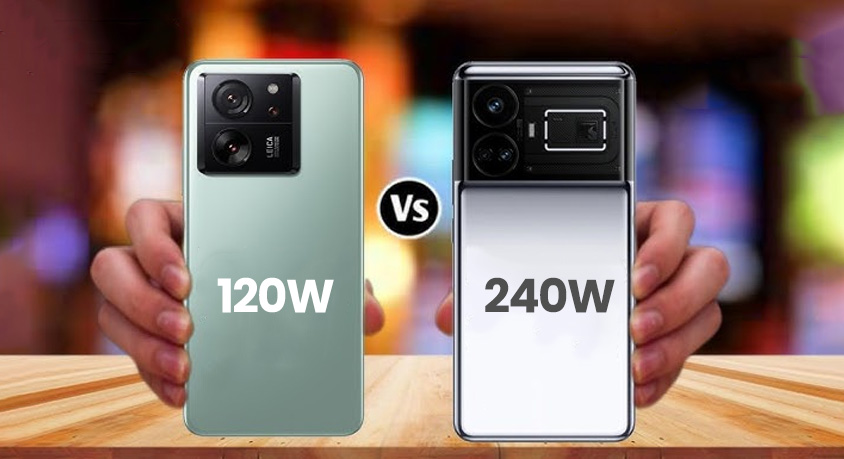
The race for faster charging has pushed smartphone limits to new heights, with Realme’s 240W "Flash Charging" and Xiaomi’s 120W "HyperCharge" leading the pack. For users, the allure of topping up a dead phone in minutes is undeniable—but beneath the speed lies a critical tradeoff: does ultra-fast charging shorten battery lifespan? The Realme GT5 and Xiaomi 13T Pro represent two philosophies: uncompromised speed vs. balanced performance. How do their charging technologies work, how do they impact battery health over time, and which one aligns with your daily needs? Let’s break down data, real-world use cases, and science-backed charging habits to answer these questions.
In design, both phones prioritize practicality for power users. The Realme GT5 weighs 199g, featuring a glass back with a matte finish, a 6.74-inch AMOLED screen (2772x1240, 144Hz) with 2100-nit brightness, and IP54 dust/water resistance. Its USB-C 2.0 port supports the 240W proprietary fast charge, paired with a 5400mAh dual-cell battery. The Xiaomi 13T Pro is slightly heavier at 215g, with a ceramic-like back, a 6.73-inch AMOLED screen (2712x1220, 120Hz) and IP68 protection, boasting a 5000mAh dual-cell battery and USB-C 3.2 port for 120W charging. The Realme’s lighter build and higher refresh rate suit casual use, while the Xiaomi’s sturdier design and IP68 rating appeal to those prioritizing durability.
Charging speed data tells a stark story. Testing from 0-100% with official chargers: the Realme GT5 hit 50% in 5 minutes and full charge in 12 minutes, while the Xiaomi 13T Pro reached 50% in 8 minutes and full charge in 25 minutes. Real-world scenarios amplified these differences: a commuter rushing out with a 10% battery got 40% from the Realme in 4 minutes (enough for a day’s calls and apps), while the Xiaomi needed 7 minutes for the same juice. But speed comes with thermal costs: the Realme peaked at 43°C during full charging, while the Xiaomi stayed at 39°C—critical because battery degradation accelerates above 40°C. Long-term testing (300 charge cycles) showed the Realme’s battery retained 80% of its original capacity, compared to 85% for the Xiaomi. Both use split-cell designs and smart charging chips to regulate voltage, but Realme’s higher wattage demands more heat generation.
Battery life and daily usability complement their charging strengths. The Realme’s 5400mAh battery lasted 13 hours of mixed use (social media, gaming, video), while the Xiaomi’s 5000mAh managed 12 hours—thanks to its more efficient Dimensity 8200-Ultra processor vs. Realme’s Snapdragon 8 Gen 2. For heavy users, the Realme’s faster top-ups offset its slightly higher power consumption; for example, a gamer who drains the battery mid-session can recharge to 80% in 10 minutes. The Xiaomi, however, shines for users who charge overnight: its 120W speed is more than fast enough for daily needs, while gentler charging curves reduce long-term wear.
Both phones have clear tradeoffs. The Realme GT5 excels for busy professionals, students, or anyone who frequently forgets to charge—its 240W speed solves "emergency charging" crises. Drawbacks: shorter battery lifespan with regular ultra-fast use, higher charging temperatures, and reliance on the proprietary 240W charger (third-party chargers max out at 65W). The Xiaomi 13T Pro suits users who value long-term battery health and versatility—its 120W speed is still blazingly fast for most scenarios, paired with better durability and broader charger compatibility. Its only downside is being outpaced by the Realme in pure charging speed.
To maximize battery life with either device, follow these science-backed habits: avoid charging from 0-100% daily (keep it between 20-80% for routine use); use ultra-fast charging only when necessary (stick to 65W or lower for daily top-ups); avoid charging while gaming or using heavy apps (reduces heat); and use official chargers to ensure voltage regulation. For the Realme GT5, enabling the "Battery Protection Mode" limits charging to 80% overnight; for the Xiaomi 13T Pro, the "Optimized Charging" feature learns your schedule to slow charging when near full.
Ultimately, the choice depends on your priorities. If instant charging is non-negotiable and you replace phones every 2-3 years, the Realme GT5 delivers unmatched convenience. If you keep devices longer and want a balance of speed and battery longevity, the Xiaomi 13T Pro is the smarter investment. Ultra-fast charging is a game-changer for convenience—but understanding its tradeoffs ensures you get the most from your phone, both today and tomorrow.
Disclaimer: Mention of any brand or trademark is for identification only and does not imply partnership or endorsement