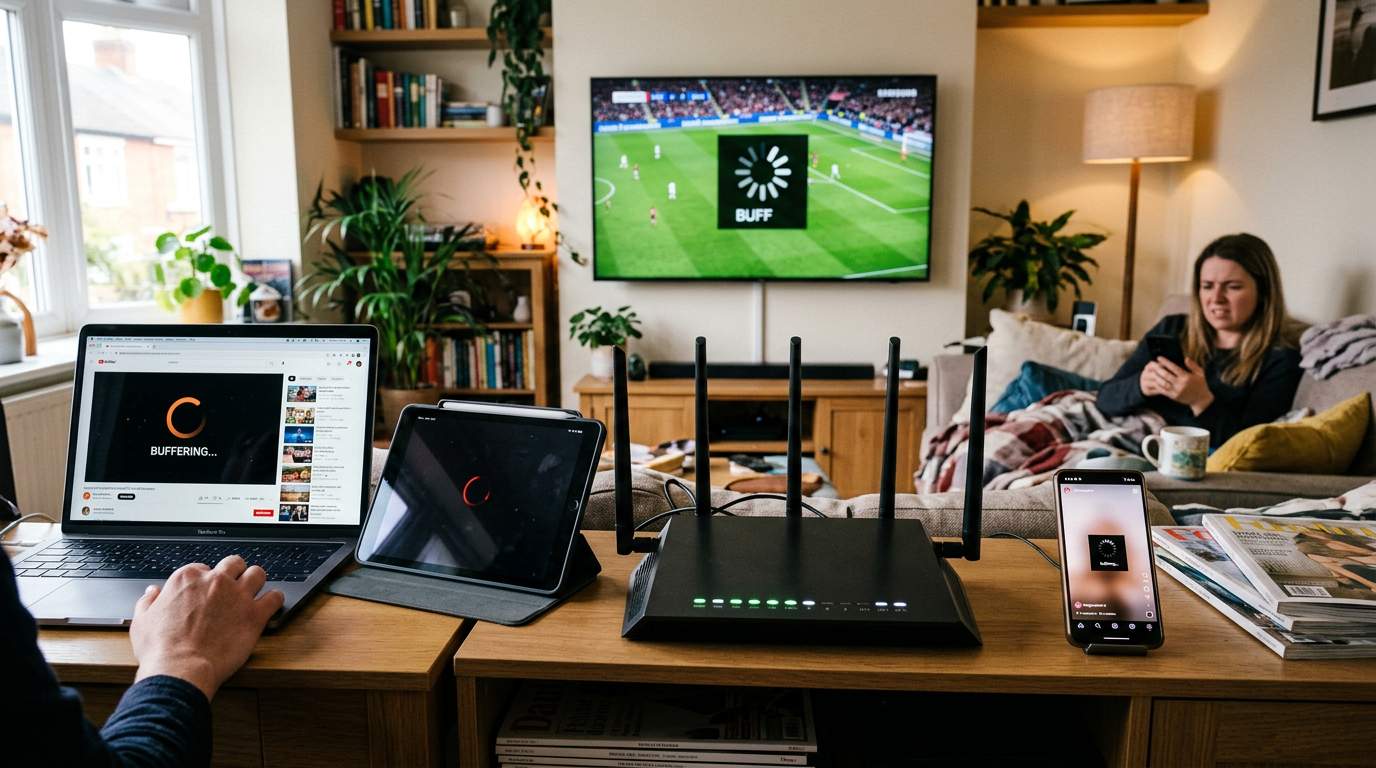
You’re staring blankly at a frozen screen, your critical work video call pixelated into oblivion. Downstairs, the kids are staging a minor rebellion because their 4K streaming just buffered for the fifth time. And all the while, you’re fuming, thinking, “I pay for gigabit internet! Why is this garbage so slow?” Trust me, I’ve been there. The gut reaction is always to shake your fist at the internet service provider, believing they’re short-changing you. But before you dial that exasperated customer service number, let's have a heart-to-heart about where the real digital demons often hide: right inside your own walls.
The common belief is that more speed from your ISP equals a perfect connection. You buy the Ferrari engine (gigabit plan), and expect track-day performance. But what if that Ferrari engine is attached to bicycle wheels, or driving on a gravel path? That, my friends, is often the sad reality of many home networks. You’re pouring a firehose amount of data into a garden hose system, and then wondering why the bucket isn't filling faster. It's not about the pipe to your house; it's about the plumbing inside.
Let's talk about your router, the unsung hero or silent saboteur of your digital life. Many of us use the basic router provided by our ISP years ago. These workhorses often support older Wi-Fi standards like Wi-Fi 5 (802.11ac) or even older. While adequate for basic browsing, they simply can't handle the sheer volume of data from multiple 4K streams, video calls, and gaming sessions simultaneously. Think of it like trying to fit a multi-lane highway's traffic onto a narrow country road. A modern Wi-Fi 6 (802.11ax) or Wi-Fi 6E router, on the other hand, is built to manage more devices more efficiently, like adding extra lanes and better traffic lights. For instance, in a typical home with 10+ connected devices, an older router might cap out at a real-world 300-400 Mbps, regardless of your gigabit plan. Upgrading can easily double or triple that internal throughput.
Then there are the dreaded Wi-Fi dead zones. You bought your dream home, but now your bedroom, the perfect spot for late-night streaming, has signal so weak it makes dial-up look appealing. Walls, floors, large appliances like microwaves and refrigerators, even your neighbor’s competing Wi-Fi signals, all conspire to degrade your wireless connection. While your internet might be blazing fast at the router, by the time it travels through two walls and past the fridge, it's often a mere trickle. This isn't your ISP's fault; it's a consequence of physics and your home's layout.
For mission-critical tasks like video conferencing for work or competitive online gaming, Wi-Fi, even good Wi-Fi, can introduce latency and packet loss that wired connections simply don't. An Ethernet cable connecting your computer directly to the router can cut latency by 10-20 milliseconds or more compared to Wi-Fi, turning a choppy, delayed conversation into a smooth, natural one. It's the difference between trying to have a conversation across a noisy room versus face-to-face. For that crucial home office setup, wiring up is a simple, often overlooked game-changer.
So, what’s the fix? For larger homes or those with significant dead zones, a mesh Wi-Fi system can be a lifesaver, spreading reliable Wi-Fi throughout your home like a well-designed irrigation system. However, even mesh systems benefit hugely from wired "backhaul" – connecting the mesh units together with Ethernet cables – rather than relying solely on wireless signals between them. This ensures each satellite unit gets a robust connection to relay to your devices, rather than just repeating a weak signal. Investing in a quality, modern router or a properly implemented mesh system isn't about buying a product; it's about investing in your daily productivity and peace of mind. Your gigabit plan can only be as good as the network infrastructure you give it to work with.
Disclaimer: Mention of any brand or trademark is for identification only and does not imply partnership or endorsement