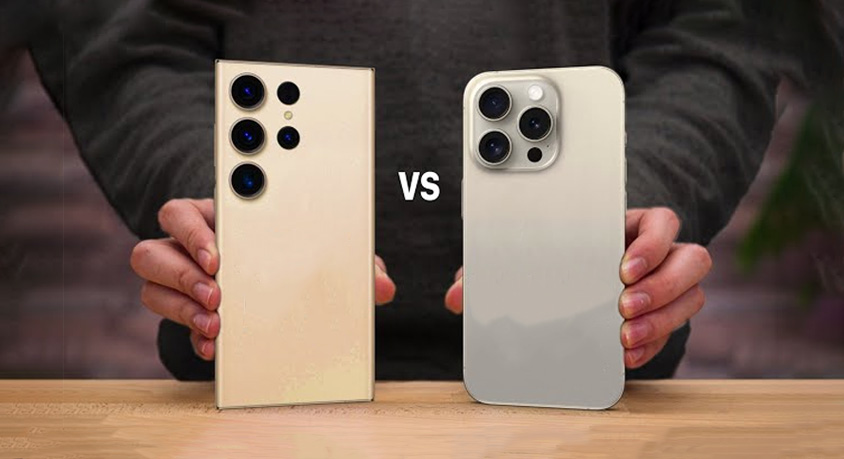
In the flagship smartphone market, two devices stand as proxies for contrasting technological philosophies: the iPhone 15 Pro Max and Galaxy S24 Ultra. Both boast top-tier hardware, but their differences extend beyond megapixels or processor cores—they reflect competing answers to a deeper question: what should a premium smartphone prioritize? Is it seamless integration, uncompromising privacy, and refined consistency, or feature breadth, creative flexibility, and technological ambition? Below is a structured analysis of their core differences in photography, AI, ecosystem, and durability, grounded in data and real-world utility.
The design and build of each device reveal its intended use. The iPhone 15 Pro Max weighs 221g with a titanium frame (20% lighter than stainless steel) and Ceramic Shield front glass, measuring 159.9x76.7x8.25mm. Its IP68 rating (6m water resistance for 30 minutes) and matte back balance durability with a sleek, minimalist aesthetic that resists fingerprints. The USB-C port replaces Lightning, aligning with universal connectivity standards, while the flat-edged design enhances grip during one-handed use. The Galaxy S24 Ultra is slightly heavier (233g) and larger (162.3x79x8.6mm), featuring a titanium frame, IP68 rating (1.5m water resistance for 30 minutes), and a 6.8-inch Dynamic AMOLED 2X flat screen (3120x1440 resolution, 120Hz adaptive refresh). Its defining feature is the integrated S Pen, stored within the chassis for instant note-taking or precision control—no extra accessories required. A business traveler appreciates the iPhone’s lighter profile during all-day carry, while a designer values the S24 Ultra’s S Pen for on-the-go sketches that translate seamlessly to editing software.
Photography capabilities highlight contrasting approaches to image capture. The iPhone 15 Pro Max employs a triple-camera system: 48MP main sensor (f/1.78, 1/1.28-inch sensor size, OIS), 12MP ultra-wide (f/2.2, 120-degree field of view), and 12MP 5x telephoto (f/2.8, periscope lens). Its strength lies in computational photography that prioritizes natural color accuracy and low-light performance—night mode reduces noise in dim restaurants while preserving ambient tones, and 4K60 Dolby Vision video delivers consistent, cinematic results. The Galaxy S24 Ultra’s quad-camera setup (200MP main, f/1.7; 12MP ultra-wide; 10MP 3x telephoto; 50MP 5x telephoto) leans into versatility and AI enhancement. Its 200MP sensor captures exceptional detail, while the dual telephoto lenses enable 10x optical-quality zoom—ideal for wildlife photographers or concert-goers capturing distant subjects. Galaxy AI adds generative editing tools: object removal, intelligent background filling, and real-time scene optimization, though these sometimes prioritize perfection over naturalism. A wedding photographer relying on consistent color for album prints may prefer the iPhone, while a travel blogger documenting diverse landscapes will benefit from the S24 Ultra’s zoom range and editing flexibility.
AI functionality exposes divergent core principles. The S24 Ultra’s Galaxy AI, powered by the Snapdragon 8 Gen 3’s Hexagon NPU (98% performance boost over predecessors), offers 100-billion-parameter on-device model support. Features like real-time two-way call translation (13 languages), meeting transcription with AI summaries, and S Pen-enabled handwritten text conversion cater to productivity and global communication. Its “circle to search” tool allows context-aware queries without app switching, blending convenience with utility. The iPhone 15 Pro Max’s AI, built on the A17 Pro chip, is more restrained but deeply integrated—focused on privacy-centric on-device processing. Live Text extraction, photo editing with object recognition, and Siri’s enhanced contextual understanding prioritize seamless, secure workflows over feature quantity. An international consultant negotiating cross-border deals will value the S24 Ultra’s translation tools, while a lawyer handling sensitive client data may prefer the iPhone’s airtight AI privacy safeguards.
Ecosystem and durability shape long-term value. Apple’s iOS 18 promises 6+ years of software updates, ensuring security patches and feature enhancements through 2030. Its ecosystem synergy—Handoff between iPhone, Mac, and iPad, Universal Clipboard, and AirDrop—creates a frictionless workflow for users invested in Apple’s ecosystem. The Galaxy S24 Ultra runs One UI 6.1 (Android 14) with 7 years of guaranteed updates, matching Apple’s longevity while offering Windows integration via DeX mode and phone screen mirroring. Durability-wise, both titanium frames resist scratches and dents, but the iPhone’s Ceramic Shield glass edges out the S24 Ultra’s Gorilla Armor in drop tests. Repair costs favor the iPhone for common issues like screen replacement, though the S24 Ultra’s expandable storage (via microSD) adds flexibility for power users. A student invested in Apple’s ecosystem will appreciate the iPhone’s seamless device sync, while a Windows-based professional may benefit from the S24 Ultra’s cross-platform compatibility.
Battery life and charging complete the practical picture. The iPhone’s 4422mAh battery delivers 11 hours of mixed use (calls, browsing, video), while the S24 Ultra’s 5000mAh cell extends to 13 hours—enough for a full workday plus evening streaming. The S24 Ultra’s 45W wired charging reaches 50% in 25 minutes, outpacing the iPhone’s 27W (50% in 30 minutes), though both support 15W wireless charging. A commuter relying on midday top-ups may prefer the S24 Ultra’s speed, while an iPhone user will appreciate MagSafe’s convenient magnetic alignment with desk chargers.
The choice ultimately hinges on core priorities, not technical superiority. The iPhone 15 Pro Max excels for users valuing ecosystem cohesion, privacy, consistent photography, and long-term software support—it is a tool of refinement, designed to reduce friction. The Galaxy S24 Ultra caters to those seeking creative flexibility, productivity-focused AI, and hardware versatility (S Pen, zoom range)—it is a tool of possibility, built to expand capabilities. Neither is perfect: the iPhone lacks the S24 Ultra’s creative tools, while the S24 Ultra’s feature density can feel overwhelming for casual users. For the majority, the decision boils down to whether you prioritize a device that does fewer things exceptionally well, or one that empowers more diverse use cases—two valid paths, each rooted in distinct visions of what a flagship smartphone can be.
Disclaimer: Mention of any brand or trademark is for identification only and does not imply partnership or endorsement